Two candidates have near-identical resumes and both pass the technical round. One will thrive in your fast-moving, collaborative team. The other will struggle with feedback and drift away within a year. Skills tests cannot separate them, and a single interview often cannot either. That gap is what a behavioral assessment tool tries to close. This guide explains what behavioral assessment tools actually measure, the main types, how to choose between them, and how to use the results fairly, without treating a profile as a verdict on a person.
What Is a Behavioral Assessment Tool?
A behavioral assessment tool is a structured way to understand how a person is likely to behave at work: how they communicate, make decisions, handle pressure, collaborate and respond to change. Instead of relying on impressions from an interview, the tool collects consistent evidence from every candidate, using questionnaires, scenarios or simulations, and turns it into comparable results.
It answers a different question from a skills test. A skills test asks “Can this person do the task?” A behavioral assessment asks “How is this person likely to work, and does that suit this role and team?” Strong hiring uses both.
The Main Types of Behavioral Assessment
Type | What It Looks At | Best Used For | Watch-Outs |
Personality inventories (for example Big Five/OCEAN) | Broad, relatively stable traits | Role fit, development planning | Self-reported, so candidates can present themselves favourably |
Behavioral style profiles (for example DISC) | Observable work and communication style | Roles where communication and working style matter, such as sales, customer-facing, client-service and team-lead roles | Describes style in a given context, so read it alongside skills evidence and role requirements |
Situational judgment tests | Choices made in realistic work scenarios | Early screening, customer-facing and people roles | Must be built around your real work situations |
Work samples and simulations | Actual behaviour in a job-like task | Finalist stage, role-specific hiring | Takes more time to design and review |
Structured behavioral interviews | Past behaviour, scored against set criteria | Final evaluation | Needs trained interviewers and a scoring guide |
No single type is best. The right choice depends on the decision you are making and the behaviours that matter for the role.
Where DISC Fits Best
DISC describes how a person tends to communicate and act at work across four styles: Dominance, Influence, Steadiness and Conscientiousness. That makes it most useful for roles where working style is a visible part of the job:
- Sales and business development: how a person persuades, handles objections and manages follow-up
- Customer-facing and client-service roles: how a person listens, stays patient and handles pressure
- Team leads and managers: how a person directs, supports and communicates with a team
- Collaborative roles: how a person is likely to work with colleagues who have different styles
DISC is quick to complete, easy for managers and candidates to understand, and works well as a starting point for interview questions and onboarding conversations. Because it describes style in a given context, it is best used for roles where that style matters, and together with skills evidence and structured interviews rather than as the only input. For roles where stable personality traits or deeper development planning matter more, many teams add a Big Five (OCEAN) profile.
What Behavioral Assessments Can and Cannot Do
They can:
- Give every candidate the same structured evaluation
- Highlight working-style strengths and potential friction areas
- Help interviewers ask sharper, role-relevant questions
- Support onboarding, coaching and team development after hiring
They cannot:
- Prove that someone will perform well on their own
- Replace skills evidence or human judgement
- Fully remove the effect of candidates managing their answers
- Justify rejecting someone simply for having a “type”
Every behavioral tool, whether DISC, Big Five, scenario-based tests or simulations, adds the most value when it is matched to the role and the behaviours that matter in it, and used together with skills evidence and structured interviews. Treat any single vendor statistic as a direction, not a guarantee.
How to Choose a Behavioral Assessment Tool
1. Define the behaviours that matter first
Before you look at any tool, list the five or six behaviours that separate strong from weak performers in this role, for example resilience, ownership, collaboration, customer focus or attention to detail. Choose the tool that measures those, not the one with the longest report.
2. Match the tool to the decision
Hiring, development and team building are different jobs. Some tools suit development conversations better than selection decisions. Be clear about which decision the result will feed.
3. Check job relevance and validity evidence
Ask the vendor how the assessment was built and what evidence supports its use for hiring. Results should connect to role requirements, not general personality labels.
4. Look for role-specific benchmarks
A raw score means little on its own. The most useful reports compare a candidate against a profile for the role and highlight strengths, gaps and areas to probe in interviews.
5. Consider candidate experience and length
Long, repetitive questionnaires cause fatigue and drop-offs. Check the time required, the clarity of instructions and the format.
6. Check integration and reporting
Results should reach hiring managers in a form they can read and act on, and sit alongside other candidate data, ideally in one system.
7. Look at fairness and data handling
Ask how the vendor supports consistent evaluation, how candidate data is stored and who can see it, and make sure this fits your policies and local rules.
8. Ask about support
Someone has to design relevant assessments, run live drives and help interpret results. Find out how much of that the vendor does and how much is left to you.
Best Practices for Using Results Fairly
- Combine, don’t isolate. Use behavioral results alongside skills assessments, structured interviews and references.
- Use them to guide, not to decide. Treat results as prompts for interview questions rather than pass or fail verdicts.
- Keep it job-related. Only act on behaviours linked to the role.
- Apply the same process to everyone. Same assessment, same conditions, same scoring.
- Train hiring managers. Make sure they understand what the report says and what it does not.
- Be transparent with candidates. Explain why you assess behaviour and how results are used.
- Review outcomes over time. Compare assessment results with later performance and adjust.
Common Mistakes
- Treating a personality or style label as a hiring decision
- Using a general profile that is not linked to the role
- Skipping skills assessment and relying only on behavioral results
- Choosing a tool because competitors use it
- Overlooking candidate experience and test length
- Not training managers to interpret reports
- Ignoring the effect of candidates presenting themselves favourably
- Never checking whether results relate to real performance
Where Behavioral Assessment Fits in a Hiring Process
A practical flow looks like this:
- Screening: structured application questions or a short situational test.
- Assessment: role-specific skills or aptitude tests plus a behavioral or psychometric assessment.
- Interview: structured behavioral interviews guided by the assessment report.
- Final check: work sample or assignment for finalists, then references.
- Decision and onboarding: use the report to plan onboarding and early coaching.
How iScalePro Approaches Behavioral Assessment
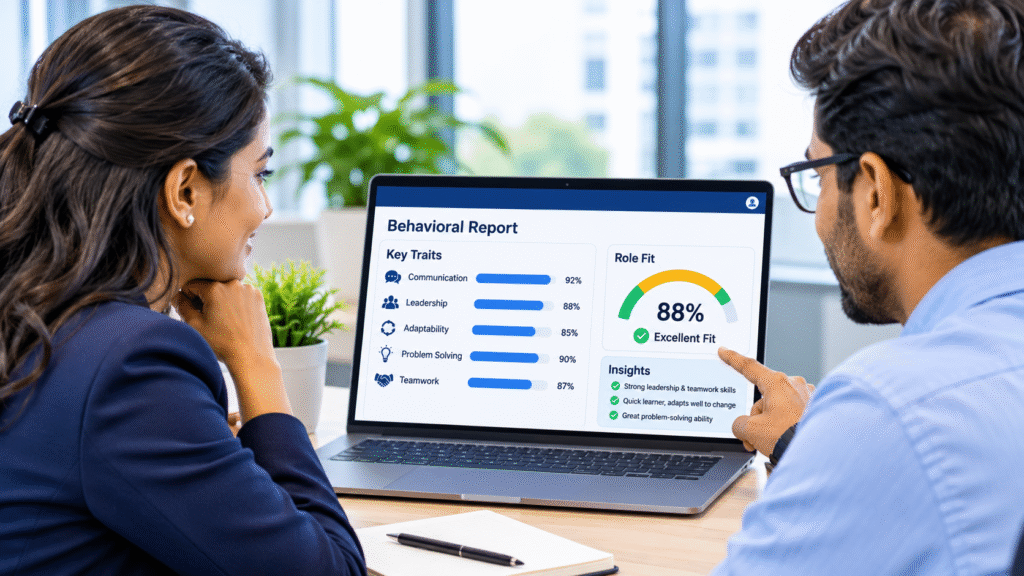
iScalePro’s psychometric assessments are built on the DISC and OCEAN (Big Five) frameworks and produce role fitment reports, trait-wise comparisons against role benchmarks, strengths and development areas, and co-working insights. They sit alongside skill assessments and assignments in the same platform, with results tracked in the Smart ATS, so hiring teams see behaviour, skills and progress together rather than in separate tools. The DISC element gives a quick, easy-to-read view of working and communication style, which is especially relevant for sales, customer-facing and team roles, while the OCEAN element adds a broader view of stable traits.
What sets iScalePro apart is the support around the tool. It is positioned as a customer success-focused talent assessment partner rather than a self-service platform:
- Customised assessments for any role. iScalePro can curate role-specific questions for corporate hiring and campus recruitment, and the team holds a discovery call first to understand your requirements.
- On-call support during recruitment drives. Dedicated on-call help during drives and campus interviews keeps assessments running smoothly.
- On-site technical support. For campus drives, the technical team can accompany customers on the ground at affordable support and travel costs.
- Customer success-driven approach. The team supports customers throughout their recruitment and evaluation process.
- Focus on quality of hire. Rather than leaving hiring decisions entirely to the customer, iScalePro works with teams to improve assessment relevance, candidate evaluation and, ultimately, quality of hire.
Psychometric assessments are available on a free trial for up to three candidates, so you can see a real report before committing. You can also review pricing plans, compare the platform on the iScalePro vs Mercer Mettl page, or read customer success stories.
It is a structured tool that evaluates how a person is likely to behave at work, covering communication, decision-making, teamwork and handling pressure, using questionnaires, scenarios or simulations scored consistently across candidates.
A skills test measures whether someone can do a task. A behavioral assessment looks at how they tend to work and whether that style suits the role and team. Good hiring combines both.
They are useful inputs, but not perfect predictors. Accuracy depends on the type of tool, how well it is tied to the role and how results are used. Use them with skills evidence and structured interviews, not on their own.
Some candidates may present themselves favourably, especially on self-report questionnaires. Scenario-based questions, consistent scoring and structured interviews that probe real examples reduce the effect, but no method removes it entirely.
They serve different purposes, so the better choice depends on the role. DISC gives a quick, easy-to-explain read of working and communication style, which suits sales, customer-facing and team roles. The Big Five offers a broader view of stable traits, which is useful for wider role-fit and development planning. Many teams use both, together with skills assessment.
It is most valuable where behaviour strongly affects performance, such as customer-facing, leadership and team-based roles. For some technical roles, skills evidence may matter more, with behavioral results as a supporting input.
iScalePro can curate role-specific assessments for corporate and campus hiring, and its team holds a discovery call to understand your requirements before preparing them. Its psychometric assessments use DISC and OCEAN to produce role fitment reports.
Yes. It provides dedicated on-call support during recruitment drives and campus interviews, and its technical team can accompany customers on-site during campus drives at affordable support and travel costs.