
DISC ASSESSMENT FOR HIRING
PERSONALITY TEST FOR RECRUITMENT
Personality Test for Recruitment to Understand Candidate Fit
A candidate who interviews brilliantly may struggle in a role that demands steady, solitary focus. Another who interviews quietly may be exactly the dependable collaborator your team needs. Interviews often cannot tell the difference.
- A personality test for recruitment adds a structured view of how candidates tend to think, communicate and work.
- iScalePro provides personality insights through DISC-based and OCEAN / Big Five-based frameworks, with reports covering Role Fit Score, strengths, development areas and suggested interview questions.
- It is designed to support your decisions alongside skills and interviews, not replace them.
Two candidates can have the same qualifications and interview equally well, yet work in completely different ways. One pushes for fast decisions, the other checks every detail. One energises a room, the other steadies it. Neither is wrong, but one may suit your role better.
A DISC assessment for hiring helps recruiters understand these behavioural tendencies in a structured way. iScalePro provides DISC-based insights within reports that also cover role fit, strengths, development areas and suggested interview questions, so your team can prepare better conversations and make more informed decisions.
What Is a Personality Test for Recruitment?
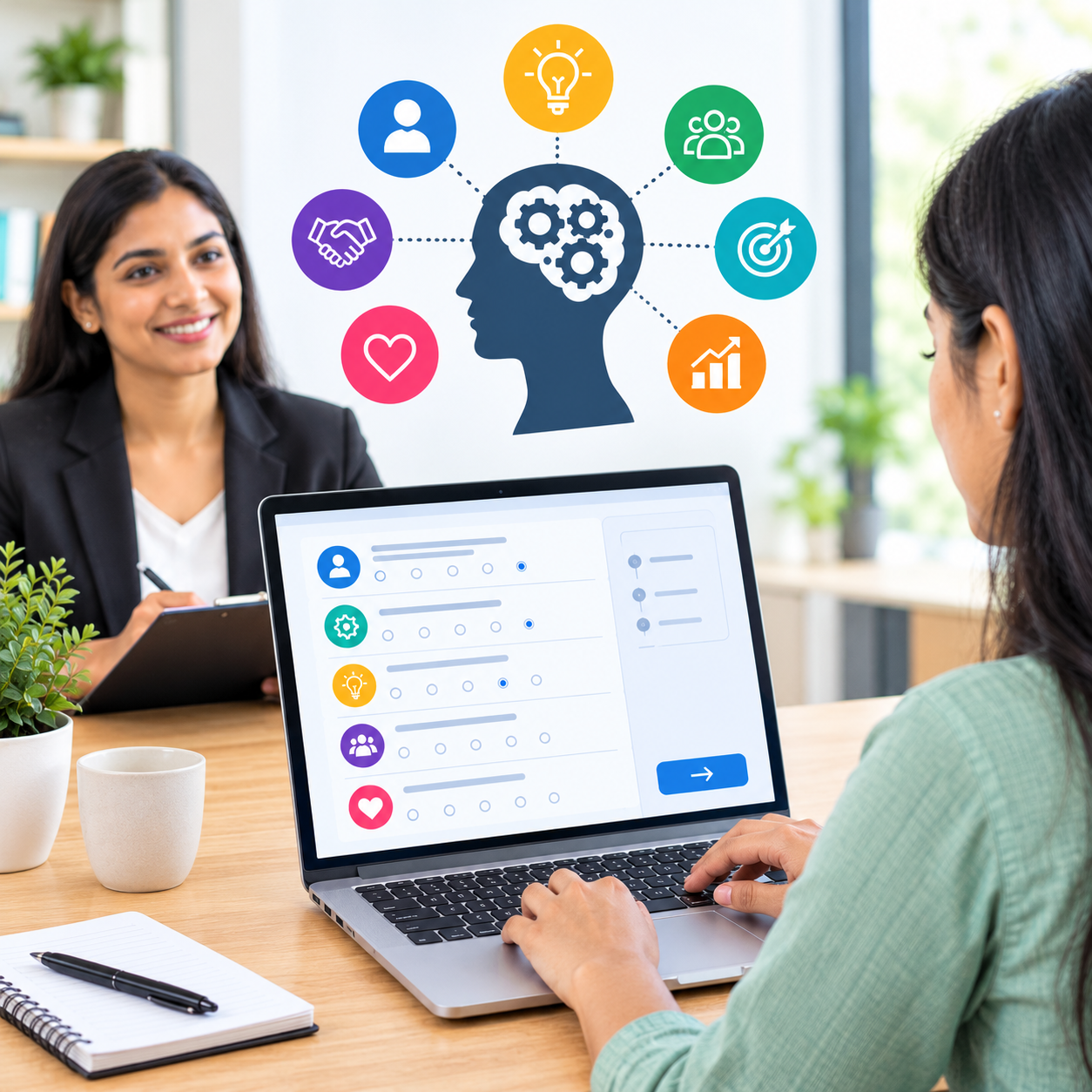
A personality test for recruitment is a structured questionnaire that describes a candidate’s typical patterns of thinking, behaving and interacting at work. Recruiters use the results to understand work style and explore role fit, alongside skills, experience and interviews.
It is not an exam. There are no right or wrong answers, and no personality is “good” or “bad”. The question is whether a profile suits the demands of a given role and team.
Why Do Recruiters Use Personality Tests?
To look beyond the interview.
Candidates prepare for interviews. Structured questionnaires add a different kind of evidence.
To compare candidates consistently
Everyone answers the same questions.
To prepare better interviews
Findings suggest where to probe.
To assess fit for team and role.
Some roles reward independence, others collaboration.
To plan onboarding and development.
Strengths and development areas help managers support new hires.
Inconsistent evaluation:
Personality results are one input among many. They do not predict success on their own.
How Automated Candidate Screening Works
Candidate application
Applicants enter your pipeline.
Candidate tracking
The Smart ATS records each candidate's stage and progress.
Assessment invitation
Candidates receive role-appropriate assessments online.
Skill evaluation
MCQ, scenario-based, written or coding responses are evaluated automatically or manually.
Psychometric evaluation
Behavioural and personality insights add context on work style and role fit.
Assignment or video evaluation
Job-specific assignments and video responses are reviewed for deeper capability and communication.
Candidate comparison
Reports let you compare candidates side by side.
Shortlisting
Move the strongest candidates forward using evidence.
Interview
Interviews focus on verified strengths and follow-up questions drawn from reports.
Trusted by these customers, and many more...


What Can a Recruitment Personality Test Help Assess?
A resume shows claimed experience. Better screening looks at several dimensions:
| Area | What it can indicate |
|---|---|
| Communication | Direct or diplomatic, concise or detailed |
| Collaboration | Tendency to lead, support, persuade or analyse in teams |
| Work style | Preference for structure, pace, autonomy |
| Adaptability | Comfort with change and ambiguity |
| Leadership tendencies | How a person may guide or influence others |
| Decision-making | Intuitive and quick, or considered and data-led |
| Emotional responses | Tendencies in handling pressure and setbacks |
| Role fit | Alignment between profile and role demands |
These are indicators of tendency. People behave differently across situations and often grow over time.
DISC vs OCEAN / Big Five Personality Assessment
| Area | DISC | OCEAN / Big Five |
|---|---|---|
| What it describes | Four workplace behaviour styles | Five broad personality traits |
| Dimensions | Dominance, Influence, Steadiness, Conscientiousness | Openness, Conscientiousness, Extraversion, Agreeableness, Neuroticism (emotional stability) |
| Focus | Observable behaviour at work, communication | Underlying trait tendencies |
| Typical value in hiring | Team dynamics, communication, working style | Deeper trait-level view, e.g. reliability, openness to change |
| Reading results | Blend of styles | Position on each trait spectrum |
| Caution | Not a skills or intelligence measure | Not a standalone predictor of performance |
Using both can provide a more rounded view than either alone. For DISC specifically, see our DISC assessment for hiring.
Personality Test and Role Fit
Can a personality test show role fit? It can indicate how a candidate’s profile aligns with the behaviours a role tends to require, but it cannot confirm that they will succeed. Role fit is strongest when personality insights are combined with skills, experience and structured interviews.
iScalePro reports translate personality insights into a Role Fit Score, role fitment summary, strengths and development areas, so recruiters can see alignment quickly and then explore it in conversation. For existing employees, see our employee role fitment test.

Personality Testing for Different Job Roles
| Area | DISC | OCEAN / Big Five |
|---|---|---|
| What it describes | Four workplace behaviour styles | Five broad personality traits |
| Dimensions | Dominance, Influence, Steadiness, Conscientiousness | Openness, Conscientiousness, Extraversion, Agreeableness, Neuroticism (emotional stability) |
| Focus | Observable behaviour at work, communication | Underlying trait tendencies |
| Typical value in hiring | Team dynamics, communication, working style | Deeper trait-level view, e.g. reliability, openness to change |
| Reading results | Blend of styles | Position on each trait spectrum |
| Caution | Not a skills or intelligence measure | Not a standalone predictor of performance |
Using both can provide a more rounded view than either alone. For DISC specifically, see our DISC assessment for hiring.
Personality Test and Role Fit
Can a personality test show role fit? It can indicate how a candidate’s profile aligns with the behaviours a role tends to require, but it cannot confirm that they will succeed. Role fit is strongest when personality insights are combined with skills, experience and structured interviews.
iScalePro reports translate personality insights into a Role Fit Score, role fitment summary, strengths and development areas, so recruiters can see alignment quickly and then explore it in conversation. For existing employees, see our employee role fitment test.
How Personality Assessment Complements Skill Testing
Personality testing shows how a person tends to work. Skill testing shows what they can do. A strong candidate decision usually needs both.
Important: personality testing should complement, not replace, skills assessments, structured interviews and other hiring evidence. A personality profile cannot tell you whether someone can write code, analyse a balance sheet or handle a client call.
Role · Behaviours worth exploring
Screen skills with a skill assessment or coding assessment.
Add personality insights to understand work style.
Use suggested interview questions to explore findings.
Weigh all evidence together.
Two successful people in the same role can have different DISC profiles. Use role requirements as a guide, not a rigid template.
How iScalePro Personality Assessment Works
DISC does not tell you who will succeed in a role. It helps you explore which behaviours the role calls for and how a candidate's tendencies may line up.
Role · Behaviours worth exploring
Identify the position and what matters for success.
Choose DISC-based and OCEAN / Big Five-based insights, along with any skill assessments.
Send assessments online.
They answer at their convenience.
Structured results are produced.
Study role fit, strengths, development areas and co-working insights.
Use suggested interview questions.
Combine with skills and interview findings.
Two successful people in the same role can have different DISC profiles. Use role requirements as a guide, not a rigid template.
Candidate Screening Software vs Manual Screening
| Area | Manual Screening | Candidate Screening Software |
|---|---|---|
| Starting point | Resume review | Resume plus structured assessments |
| Time per candidate | High | Reduced for objective stages through automation |
| Consistency | Varies by recruiter | Same criteria for every candidate |
| Skill validation | Claims and call answers | Demonstrated through assessments |
| Behavioural insight | Gut feel in interviews | Psychometric insights and role fit |
| Tracking | Spreadsheets, email | Smart ATS with assessment workflows |
| Comparison | Difficult | Side-by-side reports |
| Scalability | Limited by recruiter hours | Handles larger candidate pools |
| Audit trail | Scattered notes | Centralised results |
Personality Assessment Reports
An indicator of alignment with the role
Where the profile is well aligned with role demands
Where support or coaching may help
How the person tends to communicate and work
How they may collaborate with colleagues
Points that warrant closer review in interviews
Prompts to explore findings
A summary to support the hiring discussion
Reports are decision support. Treat flags as questions to explore, not reasons to reject automatically.
Benefits of Personality Testing in Recruitment
Why Choose iScalePro?
Two frameworks
DISC-based and OCEAN / Big Five-based insights
Role-focused reports
Role Fit Score, strengths, development areas and growth potential
Practical outputs
Co-working insights, hiring risk indicators and suggested interview questions
One platform
Combine personality insights with skill, coding and assignment assessments within iScalePro's talent assessment platform
Responsible framing
Results support human decisions and are used with other evidence
Beyond hiring
The same insights support development and internal mobility
For a wider view of workplace behaviours, explore the behavioral assessment tool.
How to Choose Candidate Screening Software
Does it go beyond resume filtering?
Look for real assessments, not just keyword matching.
Can assessments be tailored to roles?
Generic tests waste candidates' time.
Does it support multiple formats?
Technical and non-technical roles need different methods.
How does evaluation work?
Check automated and manual options and how results are presented.
Is there candidate tracking?
A connected workflow saves time.
How is assessment integrity maintained?
Ask about proctoring.
Are reports clear for hiring managers?
Insights should be readable and actionable.
Is psychometric use responsible?
Results should support, not replace, human judgement. See our personality test for recruitment and DISC assessment for hiring pages.
Can it grow with you?
Consider development and internal mobility use too.
Book an iScalePro Demo
Bring a live role and your current screening process. We will show how assessments, tracking and reports could work for your team.
FAQ's
What is a personality test for recruitment?
It is a structured questionnaire that describes how a candidate typically thinks, communicates and works. Recruiters use the results to understand work style and explore role fit, together with skills assessments and interviews. It is not a pass-or-fail exam.
Are personality tests accurate for hiring?
They can provide useful structured insight into tendencies, but they are not a standalone predictor of job performance. Their value depends on the framework used, how questions are designed and how results are interpreted. Combine them with skills, interviews and references.
Which personality frameworks does iScalePro use?
iScalePro offers psychometric insights based on DISC and on the OCEAN / Big Five model. DISC describes workplace behaviour styles, while OCEAN describes five broad personality traits. Together they provide a rounded view.
Can a personality test replace an interview?
No. Interviews allow recruiters to explore experience, motivation and context in conversation. A personality test adds structured insight and helps shape interview questions, but it works best as a complement, not a substitute.
What does a personality assessment report include?
iScalePro reports can include a Role Fit Score, strengths, development areas, behavioural insights, co-working insights, hiring risk indicators, suggested interview questions and recommendations to support the hiring discussion.
Can personality tests be taken online?
Yes. Candidates complete iScalePro’s psychometric assessments online after receiving an invitation. This suits remote hiring, campus drives and high-volume recruitment, with structured reports available afterwards.
Can personality assessment be used for existing employees?
Yes. Employee personality assessment can highlight strengths, development areas and collaboration style, supporting coaching, team planning and internal mobility. Share results openly and use them to support growth, not to label people.
How should recruiters interpret personality results?
Read them as tendencies, not fixed labels. Look at role fit and strengths, treat risk indicators as prompts for questions, and weigh everything alongside skills and interview findings. Avoid rejecting candidates on a single trait or score.
Can personality tests be customised for different roles?
Yes. Assessments can be set up for a specific role, and reports interpret the profile against role expectations. This keeps the focus on traits relevant to the position instead of a generic profile.
How do I start using personality assessments with iScalePro?
Book a free demo. We will show sample reports, explain how role profiles are set up and discuss how personality insights can fit alongside skill assessments in your hiring workflow.