
DISC ASSESSMENT FOR HIRING
EMPLOYEE ROLE FITMENT TEST
Employee Role Fitment Test for Better Workforce Decisions
Hiring is only the first role decision. Teams change, strategies shift and people grow. Months or years later, HR still has to answer: is this person in the right role, ready for the next one, or in need of support?
- iScalePro's employee role fitment test helps HR teams and managers assess how well employees align with their current roles and where they could grow.
- Combining skills, behavioural insights, growth potential and skill readiness, it provides structured information for internal mobility, promotions and upskilling decisions.
What Is an Employee Role Fitment Test?
A personality test for recruitment is a structured questionnaire that describes a candidate’s typical patterns of thinking, behaving and interacting at work. Recruiters use the results to understand work style and explore role fit, alongside skills, experience and interviews.
It is not an exam. There are no right or wrong answers, and no personality is “good” or “bad”. The question is whether a profile suits the demands of a given role and team.
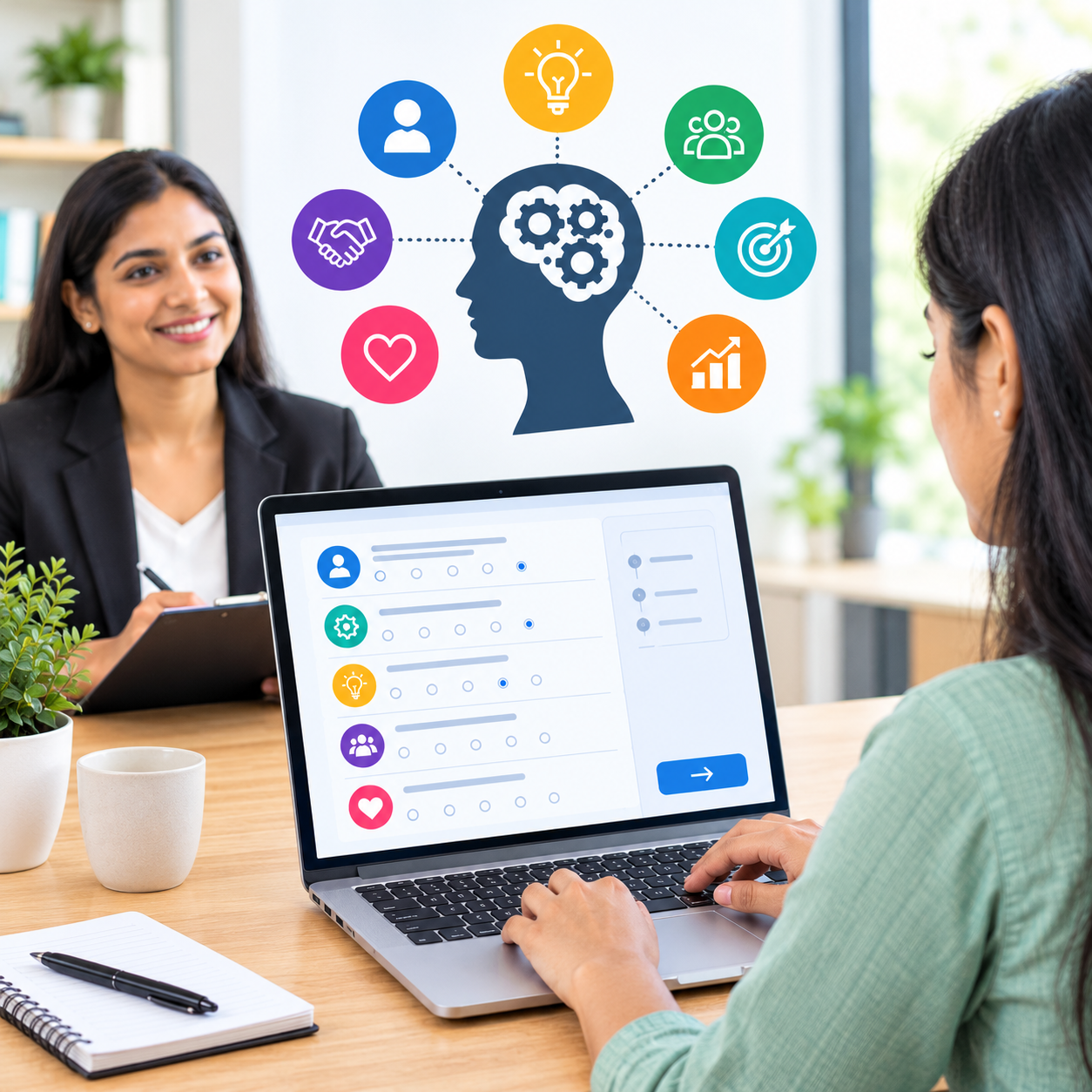
What Is an Employee Role Fitment Test?
An employee role fitment test is an assessment that evaluates how well an existing employee's skills, behaviour and strengths align with the requirements of a role.
HR and managers use it to support decisions on development, internal moves and promotions.
Is this employee well matched to their current responsibilities?
Where are their strengths and development needs?
Do they show potential for a different or larger role?
What skills should they build next?
It is a decision-support tool. It does not replace manager judgement, performance history or direct conversation.
Why Role Fit Matters After Hiring
Roles evolve.
Responsibilities change as the business grows.
Strong people can sit in the wrong seat
Skills may transfer, but work style may not fit the new demands.
Promotions carry risk
Excellent individual contributors do not automatically become effective managers.
Retention is affected
- Employees who see no growth path may look elsewhere.
Training budgets need direction
Without data, upskilling can be generic
Inconsistent evaluation:
How Automated Candidate Screening Works
Candidate application
Applicants enter your pipeline.
Candidate tracking
The Smart ATS records each candidate's stage and progress.
Assessment invitation
Candidates receive role-appropriate assessments online.
Skill evaluation
MCQ, scenario-based, written or coding responses are evaluated automatically or manually.
Psychometric evaluation
Behavioural and personality insights add context on work style and role fit.
Assignment or video evaluation
Job-specific assignments and video responses are reviewed for deeper capability and communication.
Candidate comparison
Reports let you compare candidates side by side.
Shortlisting
Move the strongest candidates forward using evidence.
Interview
Interviews focus on verified strengths and follow-up questions drawn from reports.
Trusted by these customers, and many more...


Assess Current Employee Role Fit
A resume shows claimed experience. Better screening looks at several dimensions:
| Dimension | What is considered |
|---|---|
| Skills | Whether current skills meet role requirements |
| Behaviour | How the employee tends to communicate, collaborate and decide |
| Competencies | How they apply knowledge in real situations |
| Cognitive ability | How they reason and learn |
| Work style | Preference for structure, pace and independence |
| Role requirements | The expectations and demands of the position |
Using multiple dimensions avoids judging role fit by a single score. Our skill assessment platform covers the skills side in detail.
Identify Employee Strengths and Development Areas
Role fitment reports highlight
Strengths
Where the employee's profile aligns well with role demands
Development areas
Where support, coaching or training may help
Behavioural strengths
Tendencies that help in teamwork or leadership
Skill gaps
Areas where capability falls short of role benchmarks
Managers can use this as a starting point for development conversations.
Sharing results openly with the employee builds trust and makes the process feel supportive, not evaluative.
Using both can provide a more rounded view than either alone. For DISC specifically, see our DISC assessment for hiring.
Role Fitment for Internal Mobility
Filling roles internally saves hiring time, preserves knowledge and gives employees growth paths.
Role fitment assessment helps HR teams:
Identify employees whose skills and behaviours suit an open role
Compare internal candidates on consistent criteria
Spot readiness gaps before a move
Plan transition support
For example, a customer support executive with strong communication and process discipline might be assessed for a customer success role.
Assessment results shape the conversation, but managers and HR still decide.
Using both can provide a more rounded view than either alone. For DISC specifically, see our DISC assessment for hiring.
Role Fitment for Promotions and Career Development
Promotion decisions often lean on past performance alone.
Role fitment adds forward-looking information:
Growth potential insights show where an employee may be able to develop
Skill readiness shows how prepared they are for the new level
Behavioural insights highlight leadership tendencies and blind spots
Development needs identify what to build before or after the move
This helps managers prepare people for new responsibilities and reduces the risk of promoting someone into a role that does not suit their strengths.
Role Fitment and Upskilling
Personality testing shows how a person tends to work. Skill testing shows what they can do. A strong candidate decision usually needs both.
Role · Behaviours worth exploring
Upskilling works best when it targets real gaps.
Assess employees against role benchmarks.
Identify skill gaps and development areas.
Plan training for those gaps.
Reassess to see progress.
This connects role fitment directly to learning and development, helping L&D leaders prioritise instead of offering the same training to everyone.
Two successful people in the same role can have different DISC profiles. Use role requirements as a guide, not a rigid template.
How iScalePro Evaluates Employee Role Fit
Role · Behaviours worth exploring
How an employee's profile aligns with the role
Insights on development possibilities
How the person may collaborate with colleagues and managers
Tendencies that add value in the role
Areas for coaching or training
How prepared an employee is for role requirements, using role benchmark insights
Two successful people in the same role can have different DISC profiles. Use role requirements as a guide, not a rigid template.
These insights draw on skill assessments and psychometric assessments (including DISC-based and OCEAN / Big Five-based insights). See our behavioral assessment tool and DISC assessment for hiring for more on behavioural insights.
Employee Role Fitment vs Performance Appraisal
DISC does not tell you who will succeed in a role. It helps you explore which behaviours the role calls for and how a candidate's tendencies may line up.
Role · Behaviours worth exploring
| Area | Role Fitment Test | Performance Appraisal |
|---|---|---|
| Looks at | Alignment of skills and behaviour with role requirements | Past results against goals |
| Time orientation | Current fit and future potential | Backward-looking |
| Data type | Structured assessment results | Manager ratings and outcomes |
| Best for | Mobility, promotion readiness, development planning | Reviews, rewards, accountability |
| Limitation | Not a measure of actual results | May miss potential and fit issues |
| Use together | Yes, they provide complementary evidence | Yes |
Two successful people in the same role can have different DISC profiles. Use role requirements as a guide, not a rigid template.
Employee Role Fitment vs Personality Testing
DISC does not tell you who will succeed in a role. It helps you explore which behaviours the role calls for and how a candidate's tendencies may line up.
Role · Behaviours worth exploring
| Area | Role Fitment Test | Personality Test |
|---|---|---|
| Scope | Skills, behaviour, role requirements, potential | Behavioural and personality tendencies |
| Question | Does this person fit this role, and how can they grow? | How does this person tend to think and work? |
| Output | Role fit, readiness, development needs | Personality profile |
| Best for | Role decisions | Understanding work style |
| Limitation | Depends on well-defined role requirements | Cannot show skills or role alignment alone |
Candidate Screening Software vs Manual Screening
| Area | Manual Screening | Candidate Screening Software |
|---|---|---|
| Starting point | Resume review | Resume plus structured assessments |
| Time per candidate | High | Reduced for objective stages through automation |
| Consistency | Varies by recruiter | Same criteria for every candidate |
| Skill validation | Claims and call answers | Demonstrated through assessments |
| Behavioural insight | Gut feel in interviews | Psychometric insights and role fit |
| Tracking | Spreadsheets, email | Smart ATS with assessment workflows |
| Comparison | Difficult | Side-by-side reports |
| Scalability | Limited by recruiter hours | Handles larger candidate pools |
| Audit trail | Scattered notes | Centralised results |
How the Employee Role Fitment Process Works
Clarify requirements, skills and behaviours.
Skills, psychometric traits or both.
Use role-based setup and AI-powered question generation where useful.
Communicate the purpose clearly and openly.
Automated and manual evaluation as appropriate.
See role fit, strengths, development areas, growth potential and skill readiness.
Managers and HR discuss findings with employees.
Plan upskilling, mobility or promotion steps, and reassess later.
Reports are decision support. Treat flags as questions to explore, not reasons to reject automatically.
Benefits for HR and Managers
Why Choose iScalePro?
For a wider view of workplace behaviours, explore the behavioral assessment tool.
Why Choose iScalePro?
Multi-dimensional assessment across skills, behaviour and cognitive ability
Role Fit insights with strengths and development areas
Growth potential and skill readiness information
Co-working insights for team planning
Role benchmark insights to compare against role expectations
One platform for hiring, development, internal mobility and upskilling, part of the wider talent assessment platform
Human-led decisions: results support managers and HR, they do not replace them
Results should be considered alongside performance history, manager input and other relevant evidence.
How to Choose Candidate Screening Software
Does it go beyond resume filtering?
Look for real assessments, not just keyword matching.
Can assessments be tailored to roles?
Generic tests waste candidates' time.
Does it support multiple formats?
Technical and non-technical roles need different methods.
How does evaluation work?
Check automated and manual options and how results are presented.
Is there candidate tracking?
A connected workflow saves time.
How is assessment integrity maintained?
Ask about proctoring.
Are reports clear for hiring managers?
Insights should be readable and actionable.
Is psychometric use responsible?
Results should support, not replace, human judgement. See our personality test for recruitment and DISC assessment for hiring pages.
Can it grow with you?
Consider development and internal mobility use too.
Book an iScalePro Demo
Bring a live role and your current screening process. We will show how assessments, tracking and reports could work for your team.
FAQ's
What is an employee role fitment test?
It is an assessment that evaluates how well an existing employee’s skills, behaviour and strengths align with a role’s requirements. HR and managers use it to support development, internal mobility and promotion decisions.
Why assess role fit for existing employees?
Roles change, and employees may be well matched or poorly matched as responsibilities evolve. Assessing fit highlights strengths, gaps and potential, so organisations can plan development and moves with more information.
Can role fitment support internal mobility?
Yes. It helps HR compare internal candidates for open roles using consistent criteria, covering skills, behaviour and readiness. It adds structured insight to mobility decisions that managers and HR then review.
Can it help with promotion decisions?
Yes, as one input. Growth potential, skill readiness and behavioural insights add forward-looking information alongside performance records. Final decisions should consider track record, manager input and business needs.
Does iScalePro assess employee skill gaps?
Yes. Skill readiness and role benchmark insights show where an employee meets or falls short of role expectations. This helps L&D teams target upskilling instead of offering generic training.
What behavioural insights are included?
Reports can include behavioural strengths, development areas, co-working insights and growth potential, drawing on psychometric assessments with DISC-based and OCEAN / Big Five-based insights.
How is a role fitment test different from a performance review?
A performance review looks back at results against goals. A role fitment test looks at alignment between the person and role requirements, and at potential. They work best together.
Should employees see their role fitment results?
Many organisations find sharing results openly, with a supportive development conversation, builds trust. Explain the purpose clearly beforehand and use results to guide growth rather than to label employees.
Can role fitment help plan workforce development?
Yes. Aggregated insights on skills, readiness and development needs help HR and L&D leaders see where capability is strong or lacking and prioritise training and succession planning.
How can I use iScalePro for employee role fitment?
Book a free demo. We will show how to define a role, select assessments, run them online and review reports, using an internal mobility or development scenario from your organisation.
SEO Metadata
SEO Title
Meta Description
Suggested URL
Primary Keyword
Secondary Keywords
Search Intent
Differentiation
SEO Metadata
SEO Title: DISC Assessment for Hiring | Role Fit Insights | iScalePro (52 chars)
Meta Description: Use DISC-based insights to understand candidate communication, work style and role fit. Structured reports with interview guidance. Book a free demo. (~154 chars)
Suggested URL: https://www.iscalepro.com/disc-assessment-for-hiring/