How reliable are psychometric tests for recruitment outcomes?
well-built psychometric tests are reliable (they give consistent scores) and moderately predictive of job performance, but they are not a crystal ball. In the most recent large re-analysis of hiring research, cognitive ability tests had a validity of .31 and conscientiousness .19, while structured interviews topped the list at .42 (Sackett et al., 2022). The practical rule: use a validated test as one input alongside a structured interview or work sample, never as the only filter.
Reliability vs validity: why both matter
Reliability asks whether a test measures consistently, for example whether a candidate scores about the same on the same scale across items or on a retest. Validity asks whether the score predicts something real, such as later job performance. A test can be perfectly reliable and still predict nothing, so you need evidence for both. A common rule of thumb, often traced to Nunnally (1978), is that internal-consistency reliability (Cronbach’s alpha) of about .70 is the minimum for research use and that higher values, around .90, are expected when decisions are made about individuals.
What the evidence says about how well different methods predict performance
A validity of .30 does not mean “30% accurate.” It is a correlation between test scores and later performance. Sackett, Zhang, Berry and Lievens (2022) revised older estimates downward after correcting for how restriction of range had been handled, so the numbers below are more conservative than the widely quoted 1998 figures.
Selection method | 1998 estimate | 2022 estimate |
Structured interview | .51 | .42 |
Job knowledge test | .48 | .40 |
Work sample test | .54 | .33 |
Cognitive ability test | .51 | .31 |
Conscientiousness (personality) | .31 | .19 |
Unstructured interview | .38 | .19 |
Sources: Schmidt & Hunter (1998), Psychological Bulletin; Sackett et al. (2022), Journal of Applied Psychology, 107(11), 2040–2068. Figures as summarised by SIOP and HumRRO (see Sources).
What this means for you: psychometric tests add real, measurable signal, particularly for roles where job-relevant skills or traits are well defined. They are weakest when used as a generic filter with no link to the job. The biggest gain comes from combining methods, for example a job-relevant aptitude or personality test plus a structured interview scored against fixed criteria.
Types of psychometric tests compared
Test type | What it measures | Typical report | Best used for | Watch out for |
Cognitive / aptitude | Reasoning, numerical, verbal ability | Score and percentile vs norm group | High-volume and campus screening | Language and test-prep effects; use local norms |
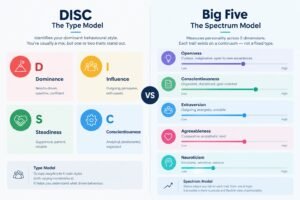
Openness, conscientiousness, extraversion, agreeableness, neuroticism | Trait profile, interview guide | Leadership and role-fit decisions | Faking in high-stakes settings; interpret with a trained reviewer | |
DISC | Behavioural and communication style | Style profile, team report | Team development, coaching | Ask for criterion-validity evidence before using for selection |
Situational judgement | Judgement in job-like scenarios | Scenario scores by competency | Managers, customer-facing roles | Scenarios must reflect Indian workplace context |
Job knowledge / skills test | Role-specific knowledge or coding skill | Skill score with breakdown | Technical and functional roles | Keep content current with the role |
How to run fair psychometric tests for leadership roles?
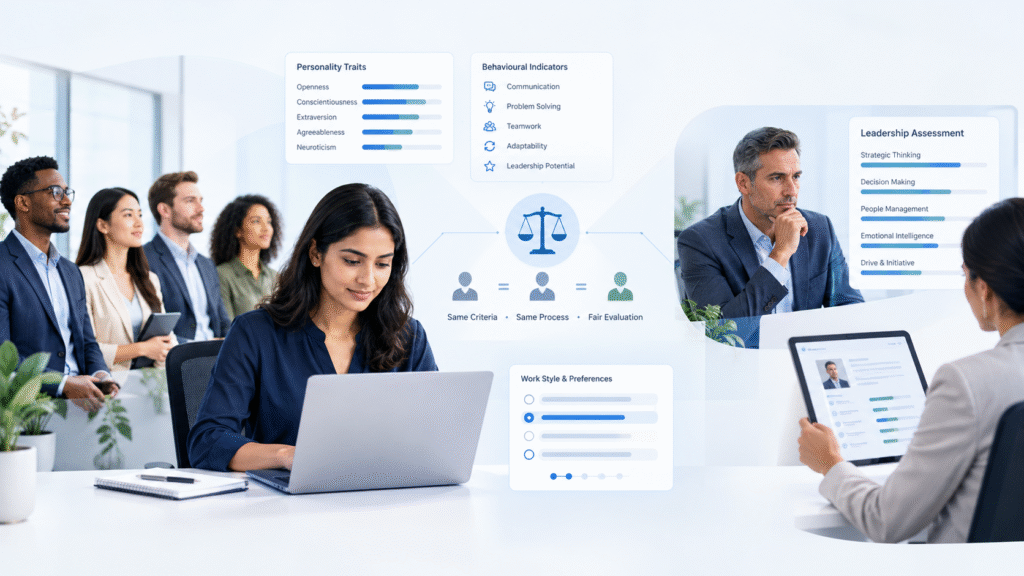
Start with a job analysis of what the leadership role actually requires, pick validated tools that measure those traits, give every candidate the same conditions and accommodations, and combine the results with structured interviews and a human decision. Then monitor outcomes by group, and obtain candidate consent for how their data is used. Fairness comes from the whole process, not from the test alone.
What personality research says about leadership
Judge, Bono, Ilies and Gerhardt (2002) meta-analysed 222 correlations from 73 samples. They found these correlations with leadership: extraversion .31, conscientiousness .28, openness .24, neuroticism −.24 and agreeableness .08. The five factors together had a multiple correlation of .48 with leadership. These are moderate effects: useful for structuring a conversation, not strong enough to make a hiring decision alone.
Culture matters too. A 2024 meta-analytic review by Javalagi, Newman and Li found that in collectivist societies, Big Five traits (extraversion and agreeableness in particular) were stronger predictors of leader effectiveness, and that honesty-humility added prediction beyond the Big Five. For Indian organisations, this is a reason to validate your own leadership profile locally rather than import a Western template unchanged.
A 7-step process for fair leadership assessment
- Define the role. Run a short job analysis: what decisions, stakeholders and outcomes define success at this level?
- Choose job-relevant measures. Prefer validated Big Five/OCEAN-style personality tools and situational judgement tests tied to your competencies.
- Check the technical evidence. Ask for the test manual: reliability coefficients, validity studies, norm-group size and whether Indian norms exist.
- Standardise conditions. Same instructions, time limits and device standards for everyone; offer reasonable accommodations for candidates with disabilities (see the Rights of Persons with Disabilities Act, 2016).
- Combine methods. Pair the test with a structured interview and, where possible, a work sample or case exercise.
- Keep a human in the loop. Use a trained reviewer to interpret reports. Do not auto-reject on a single score.
- Monitor outcomes. Compare pass rates and scores by gender, college tier and language medium, and review items or cut-offs when gaps are large. (The US “four-fifths” guideline is a common screening heuristic, not an Indian legal standard.)
Data protection for candidate assessments in India
Assessment responses and scores are personal data. India’s Digital Personal Data Protection Rules, 2025 were notified in November 2025 under the DPDP Act, 2023, with a phased rollout in which the core notice, consent, security and breach-reporting rules apply from May 2027. Start now: a clear standalone notice before testing, defined retention periods, restricted access to reports and a way for candidates to raise concerns. This is general information, not legal advice. Have counsel confirm obligations for your organisation.
Indian hiring and campus-hiring use cases
- Campus drives: use short aptitude and skills tests for the first screen across thousands of students, with remote proctoring and the option of regional-language instructions. Follow with structured interviews for shortlisted candidates.
- Lateral hiring: pair a role-specific skills test with a personality or situational-judgement report so interviewers get a focused interview guide.
- Internal promotions and succession: use OCEAN-style profiles and situational judgement tests to give managers consistent, comparable evidence across candidates.
- Leadership hiring: use personality and judgement measures to structure a panel conversation, with a trained reviewer interpreting results.
How to choose a psychometric assessment platform: checklist
- Technical manual available with reliability (alpha, test–retest) and validity evidence
- Norm groups that include candidates from India, by role level
- Tests mapped to your job analysis, not generic
- Report types match your decision (selection report vs development report)
- Proctoring features suitable for campus and remote testing, with a clear candidate privacy notice
- Integration with your ATS or HRIS (ask for the supported list and setup time)
- Accessibility and accommodation options for candidates with disabilities
- Language support appropriate for your candidate pool
- Group-level reporting to monitor fairness over time
- Clear pricing model (per candidate, per test or subscription) and data-retention terms
What iScalePro offers
iScalePro is an AI-powered, unified talent assessment platform that helps organizations evaluate skills, competencies, cognitive abilities, and personality traits for hiring, employee development, and campus placements. It supports Skill-First, Competency-First, and Multi-Dimensional assessments, with AI-powered evaluation, proctoring, and actionable talent insights.
Capability | Details |
Test library | Technical and functional skills, aptitude, cognitive ability, psychometric assessments (DISC & OCEAN), scenario-based MCQs, descriptive Q&A, coding tests (100+ programming languages), video/audio assessments, and assignments. AI-powered question generation based on job descriptions. |
Report types | DISC and OCEAN personality reports, Skill & Competency Reports, Role Fitment Analysis, Cognitive & Aptitude Reports, Hiring Recommendations, Behavioral Insights, Skill Gap Analysis, and Team/Cohort Analytics. |
Proctoring | Basic and advanced AI-assisted proctoring, including tab-switch monitoring, random photo capture, face and noise detection, multiple-monitor detection, browser restrictions, and session replay for reviewing suspicious activities. |
ATS integrations | Built-in Smart ATS (Beta) supporting candidate tracking, bulk invitations, assessment workflows, and hiring pipelines. Third-party ATS integrations are not yet confirmed. |
Languages | English, Hindi, and Gujarati for assessments, with support for 100+ programming languages in coding evaluations. |
Pricing model | Flexible pay-as-you-go credit model with non-expiring credits. Skill assessments start at ₹50 per candidate; psychometric assessments are typically ₹300 per candidate. Volume-based and enterprise pricing available. |
Campus-hiring support | Bulk campus assessments, placement-readiness evaluation, aptitude and technical screening, psychometric profiling, coding assessments, hackathon screening, and institution-level student performance analytics. |
Well-built tests give consistent scores (reliability is often reported as a Cronbach’s alpha of 0.80 or higher) and moderately predict job performance. In the 2022 Sackett et al. meta-analysis, cognitive ability tests had a validity of .31 and conscientiousness .19. They work best combined with structured interviews or work samples, not used alone.
Reliability means a test gives consistent results (the same person scores similarly across items or over time). Validity means the scores actually predict something that matters, such as job performance. A test can be reliable without being valid, so employers should ask vendors for both.
No. Personality measures correlate moderately with leadership (for example, extraversion .31 and conscientiousness .28 in Judge et al., 2002), so they should inform a decision alongside structured interviews, work samples and references, with a human making the final call.
The strongest published meta-analytic evidence on personality and leadership uses the Big Five (OCEAN) model. DISC is commonly used for communication-style and development conversations, so ask any vendor for criterion-validity evidence before using DISC alone for selection.
Use job-analysis-based tests, offer the test in a language candidates can comfortably use, give equal test conditions and accommodations, compare pass rates across groups such as gender, college tier and language medium, and keep a human reviewer on every decision.