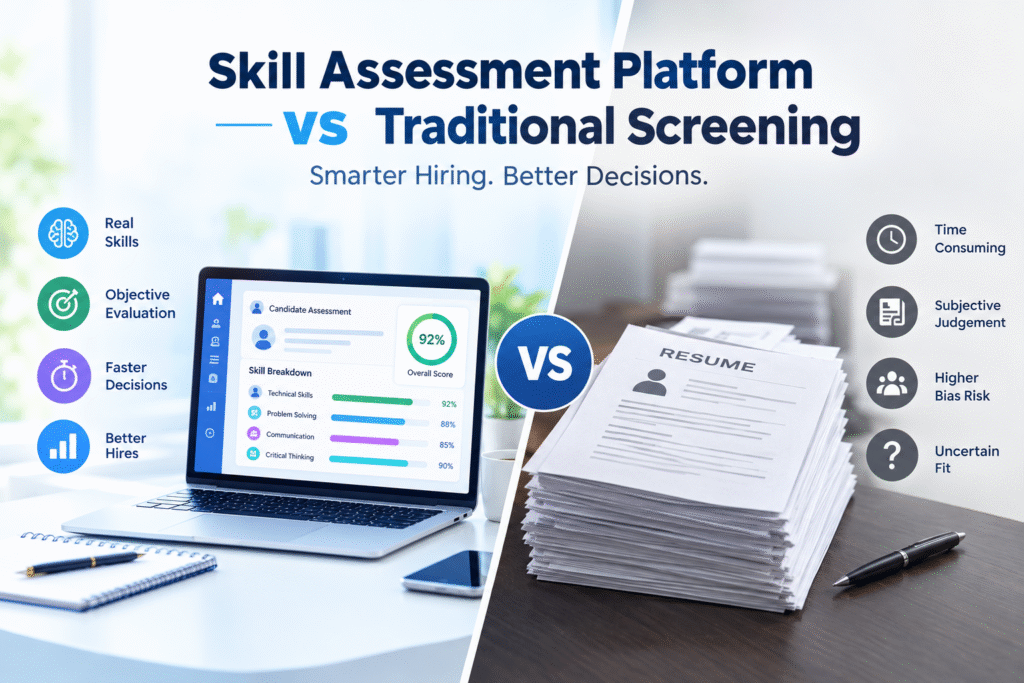
A resume tells you what a candidate says they can do. An assessment tells you what they can actually do. That gap — between claimed experience and demonstrated ability — is the core reason “skill assessment platform vs traditional screening” has become one of the more consequential decisions a hiring team makes in 2026. Both approaches aim to answer the same question: who’s actually right for this role? But they get there very differently, with real differences in speed, bias risk, and how predictive the result turns out to be. This guide breaks down how the two compare, where each genuinely still has a place, and what to look for if you’re evaluating a skill assessment platform for your own hiring process.
What Is Traditional Candidate Screening?
Traditional screening typically relies on resumes, cover letters, degree and pedigree signals, years of experience, and unstructured interviews to narrow a candidate pool. A recruiter or hiring manager reviews applications, shortlists based on these proxies, and conversations proceed from there — often without any standardised, job-specific evidence of what the candidate can actually do.
This approach is familiar, requires no new tooling, and works reasonably well when hiring volume is low and roles are simple to evaluate through conversation alone. Its core limitation is that resumes and interviews are proxies for ability, not direct measures of it — and proxies built on titles, institutions, and self-reported experience are vulnerable to both inaccuracy and bias.
What Is a Skill Assessment Platform?
A skill assessment platform replaces or supplements resume-based filtering with structured, role-specific tests — covering technical skills, job simulations, cognitive reasoning, and often psychometric or behavioural traits — administered consistently to every candidate and scored against a defined benchmark for the role. Rather than inferring ability from a candidate’s job history, it measures ability more directly, before the interview stage even begins.
Modern platforms typically go further than a single test: combining skill assessments with psychometric insight, structured assignments, and applicant tracking, so hiring teams see a fuller picture of fit — not just a pass/fail score.
Skill Assessment Platform vs Traditional Screening: Key Differences
| Factor | Traditional Screening | Skill Assessment Platform |
| What it measures | Claimed experience: titles, degrees, years | Demonstrated ability: tested skills, reasoning, traits |
| Consistency | Varies by reviewer and interview style | Standardised across all candidates |
| Bias exposure | Higher — names, schools, and networks influence decisions | Lower, when scored consistently against a defined benchmark |
| Speed at volume | Slows down significantly as applications grow | Scales efficiently with automated scoring |
| Evidence base | Self-reported, not independently verified | Directly observed through tasks and tests |
| Best suited for | Very low-volume, informal hiring | Role-specific hiring at any volume, especially bulk or technical roles |
Neither column is inherently “wrong” for every situation — but as application volumes grow and roles become more technical or specialised, the gap between the two approaches tends to widen in favour of structured assessment.
Why Traditional Screening Falls Short in 2026
A few forces have made resume-first screening a weaker filter than it once was:
- AI-written resumes. Polished, keyword-optimised resumes are now easy to produce, making it harder to distinguish genuinely strong candidates from well-written applications.
- Rising application volumes. With more applicants per opening than in previous years, manual resume review increasingly becomes a bottleneck rather than a genuine evaluation step.
- Limited predictive power. Multiple hiring studies and industry surveys point to resumes and unstructured interviews as comparatively weak predictors of on-the-job performance, since they rely on proxies — titles, schools, years of experience — that don’t directly measure the skills a role actually requires.
- Bias risk. Names, educational institutions, and career gaps can all influence resume screening in ways that have little to do with a candidate’s actual capability, even when reviewers don’t intend it.
What Skill Assessment Platforms Add
- Role-specific evaluation. Tests built around the actual demands of a role — coding challenges for engineers, case-style scenarios for sales, structured Q&A for domain knowledge — rather than one generic aptitude test for every opening.
- Multiple formats. MCQs, coding tests, written responses, assignments, and video responses, suited to different roles and seniority levels.
- Proctoring and integrity controls. Secure, monitored test environments that make remote assessment reliable for large-scale or campus hiring.
- Beyond skills alone. Many platforms now layer in psychometric or behavioural insight — how someone is likely to work and collaborate — alongside pure skill measurement, giving a more rounded view than a technical score by itself.
- Workflow integration. Assessments connected to applicant tracking, so results feed directly into hiring decisions instead of sitting in a separate spreadsheet.
Accuracy and Predictive Value: What the Research Suggests
Industry research and multiple 2026 hiring surveys point to a consistent pattern: structured, validated assessments tend to predict on-the-job performance more reliably than resume review and unstructured interviews alone, and many organisations report meaningful reductions in time-to-hire after shifting toward skills-based screening. Exact figures vary considerably across studies, methodologies, and the specific tools involved, so treat any single statistic — including ones published by assessment vendors themselves — as indicative of a direction rather than a universal guarantee. The more consistent finding across sources is directional: structured measurement outperforms unstructured judgment, even if the precise magnitude differs by study.
Does Candidate Experience Actually Matter Here?
Multiple recent hiring surveys report that a majority of candidates say they prefer a process that includes a skills-based assessment, either alongside or instead of resume review — largely because it gives them a chance to demonstrate ability directly rather than being filtered out on a credential or keyword mismatch. Flexible scheduling for assessments also tends to widen the usable candidate pool, since it doesn’t penalise applicants juggling other commitments during a job search.
Common Objections to Skill Assessment Platforms
“It adds a step and slows things down.” In practice, automated scoring and clearer shortlists often reduce the number of unqualified candidates reaching interview stage, which tends to offset the extra step with faster downstream screening.
“Candidates will just cheat.” This is why proctoring, time limits, and varied question formats matter — a credible platform builds integrity controls in rather than assuming candidates will behave.
“It’s expensive to set up.” Costs vary significantly by platform and scale; some solutions price per candidate rather than requiring large upfront licensing, which can make assessment accessible even for smaller hiring teams.
“We’ll lose the human element.” Structured assessment is meant to narrow the pool more accurately before the interview — not replace the interview. The conversation still happens; it’s just better informed.
When Traditional Screening Still Has a Role
Resumes and conversations aren’t obsolete. They remain useful for understanding career narrative, communication style, and cultural fit — dimensions that are harder to capture through a test alone. For very small teams hiring occasionally, the overhead of setting up structured assessment may not be worth it. In most other cases, though, the strongest approach tends to combine both: structured assessment to filter accurately and at scale, followed by human conversation to evaluate fit and finalise the decision — rather than treating the two as mutually exclusive.
How to Choose a Skill Assessment Platform
- Does it support role-specific tests, or only generic, one-size-fits-all assessments?
- Does it go beyond pure skills to include psychometric, cognitive, or behavioural insight where relevant?
- Does it include proctoring suitable for remote and large-scale hiring?
- Does it integrate with your ATS or hiring workflow, or will results live in a disconnected system?
- Is pricing transparent and scalable, so cost doesn’t become a barrier to adopting structured assessment?
- Does it provide actionable reports, not just a raw score — strengths, gaps, and interview guidance that help hiring managers act on the result?
How iScalePro Brings Skill Assessment and Traditional Hiring Together
iScalePro’s skill assessments are built role-by-role with AI-powered question generation across MCQ, Q&A, coding, and video formats, backed by secure proctoring — and they sit alongside psychometric assessments based on DISC and OCEAN frameworks, so hiring teams see skills, competencies, behavioural traits, and cognitive ability together rather than in isolation. Results flow directly into our Smart ATS, keeping candidate tracking and evaluation in one connected workflow instead of scattered across spreadsheets and email threads.
Enterprise-grade assessments start at ₹50 per candidate, and teams can see how the platform compares to other tools on our iScalePro vs Mercer Mettl comparison page, or review current pricing plans directly. Organisations already using the platform have shared their results in our customer success stories.
Curious how structured assessment would change your shortlist? Book a free demo to see iScalePro against your own hiring workflow.