Ask three HR teams which psychometric test they use for hiring, and you’ll likely get three different answers — DISC, the Big Five (OCEAN), or some combination of both. Both frameworks claim to help predict how a candidate will actually behave on the job, but they were built differently, measure different things, and hold up differently under scientific scrutiny. If you’re choosing a psychometric test for recruitment, understanding what DISC and Big Five actually measure — and where each genuinely helps — matters more than picking whichever one a vendor pitches hardest.
What Is a Psychometric Test for Recruitment?
A psychometric test for recruitment is a standardised assessment used to measure a candidate’s personality traits, behavioural tendencies, or cognitive style, typically to predict how well they’ll perform and fit within a specific role or team. Unlike a skills test, which measures what someone can do, a psychometric test aims to measure how someone tends to think, communicate, and work — information that’s harder to capture from a resume or a single interview.
What Is DISC?
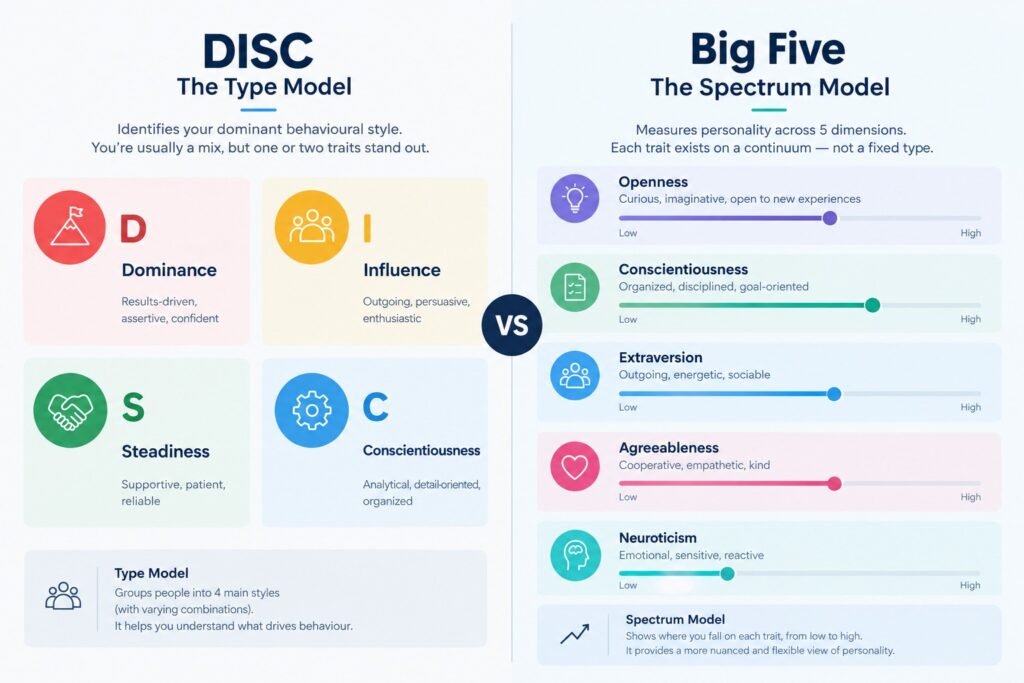
DISC measures observable behaviour across four dimensions: Dominance, Influence, Steadiness, and Conscientiousness. It typically sorts respondents into a primary behavioural style — for example, someone high in “D” tends to be direct and results-driven, while someone high in “S” tends to be steady and supportive. DISC is quick to complete, easy to explain to non-specialists, and widely used for team communication workshops, sales training, and quick behavioural snapshots during hiring conversations.
Its behavioural focus is also its main limitation: DISC describes how someone tends to act in a given context, which can shift with role, stress, or environment, rather than measuring more stable underlying personality traits.
What Is the Big Five (OCEAN)?
The Big Five — often remembered by the acronym OCEAN — measures five broad personality dimensions: Openness to experience, Conscientiousness, Extraversion, Agreeableness, and Neuroticism (sometimes reframed as emotional stability in workplace tools). Rather than sorting people into types, it places each person somewhere on a spectrum for each trait. It’s widely regarded in academic personality psychology as the most thoroughly researched and validated personality framework in current use, with decades of peer-reviewed study behind it.
DISC vs Big Five: Key Differences
| Factor | DISC | Big Five (OCEAN) |
| What it measures | Observable behavioural style in a given context | Five broad, underlying personality traits |
| Output format | A primary type or style (D, I, S, C) | A position on five continuous spectrums |
| Stability over time | Can shift with role, stress, or environment | Relatively stable through adulthood |
| Scientific standing | Widely used, but limited peer-reviewed predictive validity | Strongest scientific validation among personality models in current use |
| Completion experience | Fast, simple, low-friction for candidates | Slightly more involved, still straightforward for most candidates |
| Best suited for | Communication style, team dynamics, quick behavioural read | Role fit, long-term hiring decisions, development planning |
Scientific Validity: What the Research Actually Says
This is the part vendors don’t always lead with, so it’s worth being direct about it. Independent reviews and academic sources generally describe DISC as having limited, inconsistently demonstrated predictive validity for job performance — it’s a useful shared vocabulary for communication and team-building, but not a strongly evidence-backed predictor of how someone will actually perform in a role. Because different DISC tools measure things somewhat differently from one vendor to another, it’s also harder to build up consistent, comparable research evidence across studies.
The Big Five fares considerably better on scientific grounding, with decades of peer-reviewed research behind it and good test-retest reliability over time. That said, it’s worth keeping expectations realistic here too — personality measures in general, including the Big Five, have been shown to have a more modest relationship with actual job performance than many hiring teams assume. Conscientiousness in particular tends to show the most consistent, documented link to job performance across occupations, but no personality framework — DISC or Big Five — should be treated as a standalone predictor of hiring success.
When DISC Works Well
- Quick behavioural snapshots during early-stage hiring conversations
- Improving communication and collaboration once a candidate joins a team
- Sales, customer-facing, and people-management training contexts
- Situations where you need a fast, easy-to-explain result that candidates and hiring managers alike can interpret without specialist training
When Big Five Works Well
- Hiring decisions where deeper role-fit and longer-term predictive insight matter
- Comparing candidates against a defined personality benchmark for a specific role
- Internal development planning, succession, and identifying high-potential employees
- Situations where you want evidence-backed, research-supported personality insight rather than a quick behavioural label
Common Mistakes When Using Psychometric Tests in Hiring
- Treating personality results as a standalone pass/fail filter. No psychometric test, DISC or Big Five, should override skills evidence and interview judgement entirely.
- Rejecting candidates purely for having the “wrong” personality type, without clear evidence that trait connects to the specific role’s requirements.
- Using free, unvalidated online tests for real hiring decisions rather than assessments built and scored for employment use.
- Ignoring legal and compliance considerations around how personality assessment results are used in hiring, which vary by jurisdiction.
- Treating DISC results as deeply predictive of performance, when the stronger evidence base sits with trait models like the Big Five.
- Using personality assessment in isolation, without combining it with skill-based or role-specific evaluation.
Should You Use DISC, Big Five, or Both?
For most recruitment use cases, the honest answer is: it depends on what decision you’re making. DISC can be a fast, low-friction way to understand communication style early in a process or to support onboarding and team-building once someone’s hired. The Big Five offers a more research-backed basis for role-fit and longer-term hiring decisions, particularly for roles where personality genuinely affects performance — client-facing roles, leadership positions, or high-collaboration teams.
Many hiring teams increasingly use both together: a quick DISC-style behavioural read alongside a Big Five-based personality profile, combined with a skills assessment for the role, rather than relying on any single framework in isolation. Neither psychometric model should be the only input into a hiring decision — they work best as one data point alongside skills evidence and structured interviews.
How iScalePro Combines DISC and OCEAN for Recruitment
iScalePro’s psychometric assessments are built on both DISC and OCEAN (Big Five) frameworks, generating Role Fitment Reports, trait-wise score comparisons against role benchmarks, strengths and development areas, and co-working insights — rather than leaving hiring teams to interpret a raw personality score on their own. This combination is intentional: DISC offers a fast, intuitive behavioural read, while OCEAN brings the research-backed depth that supports more confident, longer-term hiring and development decisions.
Psychometric assessments are available on a free trial for up to three candidates, so hiring teams can evaluate the reports before committing. For teams that also need skill assessments alongside psychometric insight, both sit together in iScalePro’s Smart ATS, so results from each stage feed into one connected candidate view. You can also compare our approach directly on the iScalePro vs Mercer Mettl page, or check current pricing plans.
Want to see a DISC and OCEAN-based role fitment report for your own hiring need? Book a free demo with iScalePro.