
DISC Assessment for Hiring to Understand Candidate Behaviour and Role Fit
Two candidates can have the same qualifications and interview equally well, yet work in completely different ways. One pushes for fast decisions, the other checks every detail. One energises a room, the other steadies it. Neither is wrong, but one may suit your role better.
A DISC assessment for hiring helps recruiters understand these behavioural tendencies in a structured way. iScalePro provides DISC-based insights within reports that also cover role fit, strengths, development areas and suggested interview questions, so your team can prepare better conversations and make more informed decisions.
Book a Free Demo | Talk to an Assessment Expert
What Is a DISC Assessment for Hiring?
A DISC assessment for hiring is a behavioural assessment that describes how a candidate tends to communicate, make decisions and work with others, using four styles: Dominance, Influence, Steadiness and Conscientiousness. Recruiters use it to understand work style and to explore how well it aligns with a role.
What DISC measures: behavioural tendencies in the workplace, such as pace, communication preference, approach to tasks and response to people and pressure. It does not measure intelligence, skills or technical knowledge.
Why recruiters use behavioural insights: interviews show how someone presents themselves. DISC adds a structured view of how they may behave day to day, which helps teams look beyond first impressions.
DISC vs technical skill assessment: a skill assessment shows what a candidate can do. A DISC assessment shows how they tend to work. Both are useful, and neither replaces the other.
How DISC Assessment Supports Recruitment
DISC-based insights can help recruiters explore:
- Communication style: Direct or diplomatic? Brief or detailed? This matters for client-facing and cross-functional roles.
- Decision-making tendencies: Quick and decisive, or careful and evidence-driven?
- Collaboration: Whether a person tends to lead, persuade, support or analyse within a team.
- Work preferences: Preference for variety or routine, independence or structure.
- Leadership behaviour: How someone may guide a team, give direction and handle disagreement.
- Adaptability: How comfortable the person may be with change and ambiguity.
- Candidate-role alignment: How the behavioural profile matches what the role demands.
These are tendencies. People adapt their behaviour to situations, and DISC should be read as a starting point for conversation.
Understanding the Four DISC Behaviour Styles
No style is better or worse. Each brings strengths and trade-offs, and each suits different roles.
| Style | Typical tendencies | Workplace example | Possible trade-off |
|---|---|---|---|
| Dominance (D) | Direct, results-focused, decisive | Takes charge of a stalled project and sets clear targets | May move faster than the team is ready for |
| Influence (I) | Outgoing, enthusiastic, persuasive | Builds rapport quickly with clients and rallies colleagues | May pay less attention to detail and follow-through |
| Steadiness (S) | Patient, dependable, supportive | Keeps a team stable during change and supports colleagues | May prefer gradual change over rapid shifts |
| Conscientiousness (C) | Analytical, careful, quality-focused | Checks data and process before signing off | May take longer to decide when information is incomplete |
Most people show a blend of two or more styles. A candidate with high Influence and moderate Conscientiousness, for example, may be sociable but also reasonably structured.
DISC Assessment for Different Job Roles
DISC does not tell you who will succeed in a role. It helps you explore which behaviours the role calls for and how a candidate’s tendencies may line up.
| Role | Behaviours worth exploring |
|---|---|
| Sales | Persuasion, resilience, comfort with targets, relationship building |
| Customer success | Patience, listening, follow-through, relationship continuity |
| Managers | Decision-making, delegation, balance between direction and support |
| Team leaders | Motivating peers, handling conflict, communicating expectations |
| HR | Empathy, discretion, structured process, communication |
| Marketing | Creativity, collaboration, attention to detail, adaptability |
| Operations | Process discipline, consistency, steadiness under pressure |
| Customer support | Calmness, clarity, patience with repetitive interactions |
Two successful people in the same role can have different DISC profiles. Use role requirements as a guide, not a rigid template.
DISC Assessment and Role Fit
Can DISC show role fit? It can help indicate how a candidate’s behavioural tendencies align with a role, but it should not be used alone. Role fit is clearer when behavioural insights are combined with skills, experience, structured interviews and references.
In iScalePro, DISC-based insights sit alongside a Role Fit Score, strengths, development areas and hiring risk indicators. A practical approach:
- Use a skill assessment to confirm capability.
- Use DISC-based insights to understand work style.
- Use suggested interview questions to explore any gaps or flags.
- Make the final decision with the full evidence in view.
DISC vs Personality Test vs Skill Assessment
| Area | DISC Assessment | Personality Test (e.g. OCEAN / Big Five) | Skill Assessment |
|---|---|---|---|
| Core question | How does the person tend to behave at work? | What are their broader personality traits? | What can the person do? |
| Focus | Four behavioural styles | Five personality dimensions | Job-related knowledge and capability |
| Best for | Communication, working style, team dynamics | Deeper trait-level understanding | Technical and functional screening |
| Result | Behavioural profile | Trait scores and profile | Scores and skill readiness |
| Limitation | Not a measure of skill or intelligence | Not a standalone predictor of performance | Does not show behaviour or fit |
| Use with | Skills and interviews | DISC, skills and interviews | Psychometric and behavioural insights |
Learn more in our guides to the personality test for recruitment and the behavioral assessment tool.
How iScalePro DISC Assessment Works
- Define the role. Identify the position and the behaviours that matter.
- Select the assessment. Choose DISC-based insights, alone or with other psychometric or skill assessments.
- Invite candidates. Candidates receive the assessment online.
- Candidates complete it. They respond to behavioural questions at their convenience.
- Reports are generated. Results appear as structured behavioural insights with role fit information.
- Review insights. See strengths, development areas, co-working insights and hiring risk indicators.
- Plan the interview. Use suggested interview questions to explore findings.
- Decide with full evidence. Combine results with skills and interview outcomes.
Benefits of DISC Assessment for Hiring
- Structured behavioural insights: Replace impressions with organised, comparable information.
- Better interview preparation: Suggested interview questions help interviewers go deeper.
- Role-fit understanding: See how a profile aligns with role expectations.
- Consistent assessment: Every candidate completes the same structure.
- Candidate comparison: Compare behavioural profiles side by side.
- Development insights: Strengths and development areas continue to be useful after hiring, supporting onboarding and employee role fitment.
Why Use iScalePro for DISC Assessment?
- DISC-based insights in readable reports
- Role Fit Score and role fitment summary to focus the discussion
- Strengths, development areas and growth potential in each profile
- Co-working insights to understand how a person may collaborate
- Hiring risk indicators that flag areas for a closer look
- Suggested interview questions to support structured interviews
- Multi-dimensional approach: combine DISC with skills, coding and assignments within iScalePro’s talent assessment platform
- Human-led decisions: reports support recruiters and do not replace their judgement
Results should be considered alongside job evidence, structured interviews and other selection inputs.
Book a Demo
See a sample DISC-based report and how it connects with role fit, interview guidance and skill assessments. Bring a role you are hiring for, and we will walk through how the assessment could work.
DISC Assessment FAQs
What is a DISC assessment for hiring?
It is a behavioural assessment that shows how a candidate tends to communicate, decide and collaborate, using four styles: Dominance, Influence, Steadiness and Conscientiousness. Recruiters use it alongside skills and interviews to understand work style and role fit.
What does DISC measure?
DISC measures behavioural tendencies at work, such as pace, communication preference, approach to tasks and response to people. It does not measure intelligence, technical skill or experience, so it should be paired with skill assessments for a complete view.
What are the four DISC personality styles?
The four styles are Dominance (direct and results-focused), Influence (outgoing and persuasive), Steadiness (patient and dependable) and Conscientiousness (analytical and detail-oriented). Most people show a blend, and no style is better or worse than another.
How does DISC help recruiters?
It gives recruiters a structured view of communication style, decision-making tendencies and collaboration preferences. This helps compare candidates consistently, prepare interview questions and discuss role fit with hiring managers based on more than first impressions.
Can DISC assessment be customised for a role?
iScalePro supports role-based assessment, so DISC-based insights can be considered against the behaviours relevant to a specific role. Reports include role fit indicators, strengths and development areas to help interpret the profile in context.
Can DISC be used for sales hiring?
Yes, as one input. DISC can show tendencies in persuasion, relationship building and drive. However, successful salespeople have varied profiles, so combine it with scenario-based skill questions, interviews and past performance evidence rather than looking for one “ideal” style.
Is DISC the same as a personality test?
Not exactly. DISC focuses on observable behavioural styles at work, while broader personality tests such as OCEAN / Big Five measure underlying traits across five dimensions. They overlap but answer slightly different questions, and some organisations use both.
Can DISC results support interview decisions?
Yes, as supporting evidence. Results can highlight areas to explore, and iScalePro reports include suggested interview questions. They should not be the sole basis for selecting or rejecting a candidate. Weigh them with skills, experience and structured interview outcomes.
Can DISC assessment be combined with skill assessments?
Yes. iScalePro lets organisations combine behavioural, skill, coding and assignment-based assessments across rounds. Pairing DISC-based insights with skill results shows both how a candidate tends to work and what they can do.
How can I use iScalePro for DISC assessment?
Book a free demo. We will show a sample report, explain how assessments are set up for a role and discuss how DISC-based insights can fit into your recruitment or employee development workflow.
Go beyond hiring for roles—hire for performance. Use behavioral and personality insights to improve employee engagement, enhance productivity, and create teams aligned to your culture.
Go beyond hiring for roles—hire for performance. Use behavioral and personality insights to improve employee engagement, enhance productivity, and create teams aligned to your culture.
Trusted by these customers, and many more...
































About iScalePro’s Online Psychometric Test
Better role and culture fit

Better Employee Engagement
Reduce Attrition & Better retention

ROI of 50 % in Employee turnover
One-stop Solution for Psychometric Assessments
- Hiring
- Employee Evaluation
- Custom Traits Evaluation
Hiring
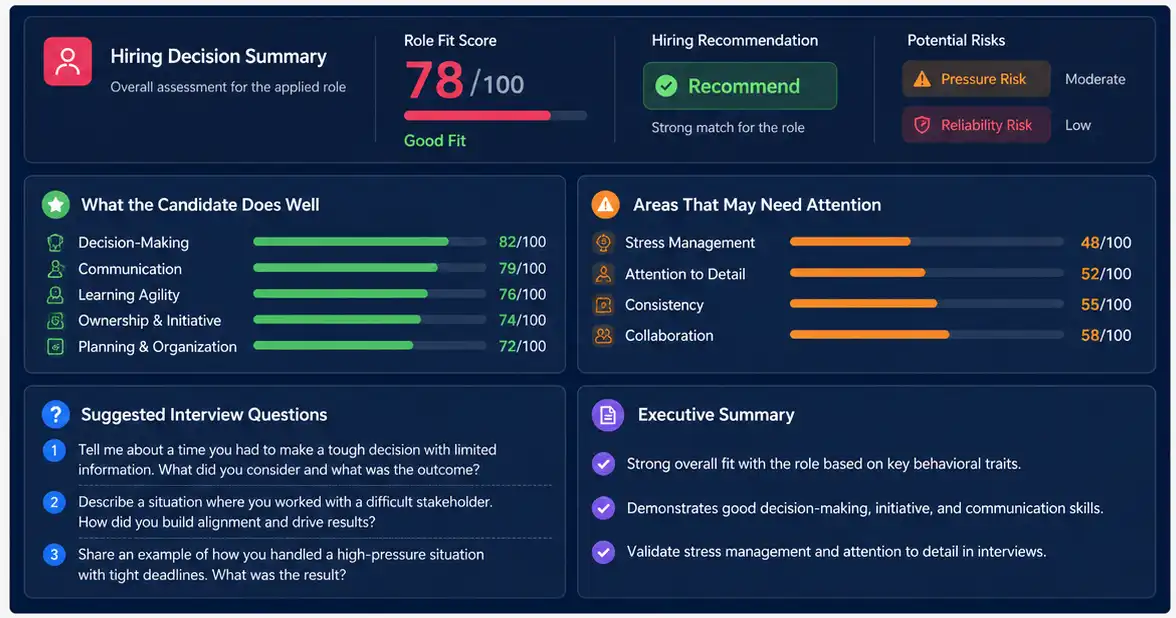
Assess candidates beyond resumes and interviews. iScalePro helps recruiters measure role fit, behavioural strengths, hiring risks, development areas, and growth potential before making a hiring decision.
The hiring report provides a clear Role Fit Score, hiring recommendation, risk indicators, strengths, watchouts, executive summary, and suggested interview questions.
Employee Psychometric Evaluation
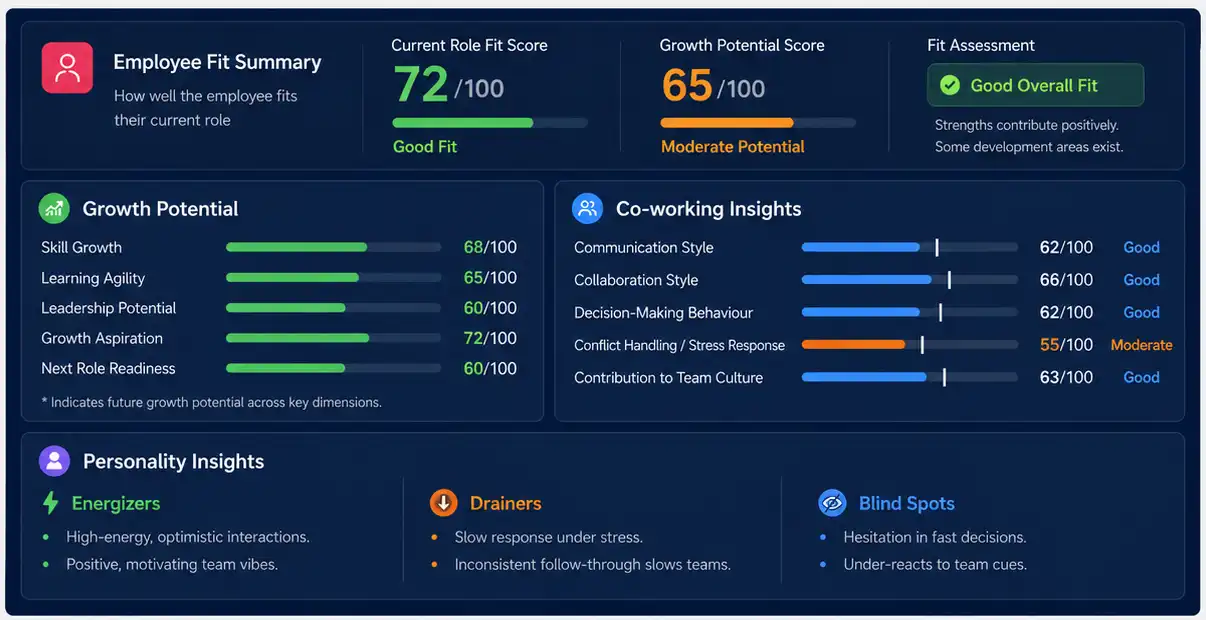
Evaluate employees beyond performance scores. iScalePro helps HR teams understand current role fit, growth potential, co-working style, behavioural strengths, blind spots, and development needs.
The employee evaluation report supports coaching, internal mobility, succession planning, and employee development decisions.
Key features:
- Current Role Fitment Score
- Growth Potential Score
- Co-working Insights
- Communication and collaboration style
- Stress response and conflict handling
- Energizers, drainers, and blind spots
- Development areas
Custom Psychometric Trait Evaluation
Create custom psychometric reports by choosing the exact traits you want to measure for each role, team, or business need.
iScalePro can assess traits such as communication, teamwork, ownership, decision-making, system thinking, technical curiosity, leadership potential, emotional balance, and role-specific behaviours.
Key features:
- Custom trait selection
- Trait-wise score and observation
- Overall score and fitment
- Strengths and development areas
- Role-specific recommendation
- Final recommendation

Sales Teams
- Identify natural persuaders & relationship builders.
- Train and retain high-performers based on behavioral strengths.

Marketing Teams
- Build creative–analytical balance in campaigns.
- Promote collaboration and innovation.

HR / Operations
- Reduce attrition with better role fitment.
- Improve communication, morale, and engagement.

Leadership
- Spot future leaders early.
- Align individual purpose with company vision.
One-stop Solution for Online Psychometric Tests
Role Fitment Summary

Detailed Role Fitment Report

Personality and Behavioural Insights

Co-Working Insights

Trait-wise Score Comparison
Gap & Development Plan
Final Recommendation (Fit / Conditional Fit / Not Fit)
One-to-One Counselling Sessions

Customized Training Sessions
See beyond skills — unlock the mindset, motivation, and potential that drive success. Get started with iScalePro.
Psychometric Test FAQs
What is a psychometric assessment and how does it help in hiring?
A psychometric assessment is a structured evaluation used to measure a candidate’s personality traits, behavioural tendencies, cognitive abilities, work style and role suitability.
iScalePro’s psychometric assessments help employers make better hiring decisions by evaluating factors such as communication, teamwork, leadership, adaptability, emotional stability, problem-solving and workplace behaviour. The platform also provides role-fit insights, behavioural strengths, potential risks and interview guidance.
By combining psychometric assessment results with skill assessments and interview performance, iScalePro helps recruiters identify candidates who not only have the required technical skills but are also more likely to fit the role, team and organisational culture. This can improve hiring accuracy, reduce bad hires and support better employee retention.
Can a psychometric test be done online?
Yes. iScalePro’s psychometric tests are fully online — candidates take the assessment from any device, in any location, with results delivered in minutes. HRs & Recruiters get instant access to a detailed Role Fitment Report, behavioural insights, and hiring recommendations without scheduling in-person sessions.
Is there a free psychometric test available?
Yes. iScalePro offers a trial version of free psychometric test for upto 3 candidates/employees. You can sign up and access the assessment platform at no cost to evaluate personality, cognitive abilities, and emotional intelligence. Enterprise plans with bulk hiring and custom trait evaluation are available with a free demo at iscalepro.com/book-demo/.
What is the difference between DISC and OCEAN assessments?
DISC assessment measures workplace behaviour styles such as Dominance, Influence, Steadiness and Conscientiousness. It helps employers understand how a candidate communicates, collaborates, leads and responds to work situations.
OCEAN assessment, also known as the Big Five personality model, measures deeper personality traits such as Openness, Conscientiousness, Extraversion, Agreeableness and Neuroticism. It helps evaluate long-term role fit, adaptability, emotional stability and growth potential.
At iScalePro, we combine DISC and OCEAN insights to provide a more complete psychometric assessment for hiring, employee evaluation, role fitment and team development.
How do psychometric assessments reduce employee attrition?
Attrition is often caused by poor role fit, cultural mismatch, or unmet growth expectations. iScalePro’s psychometric assessments identify candidates whose personality traits, motivations, and working styles align with the role and the organisation. The platform also surfaces employee engagement insights and blind spots, enabling HR teams to intervene early, support development, and improve retention — delivering an average 50% ROI reduction in employee turnover costs.